


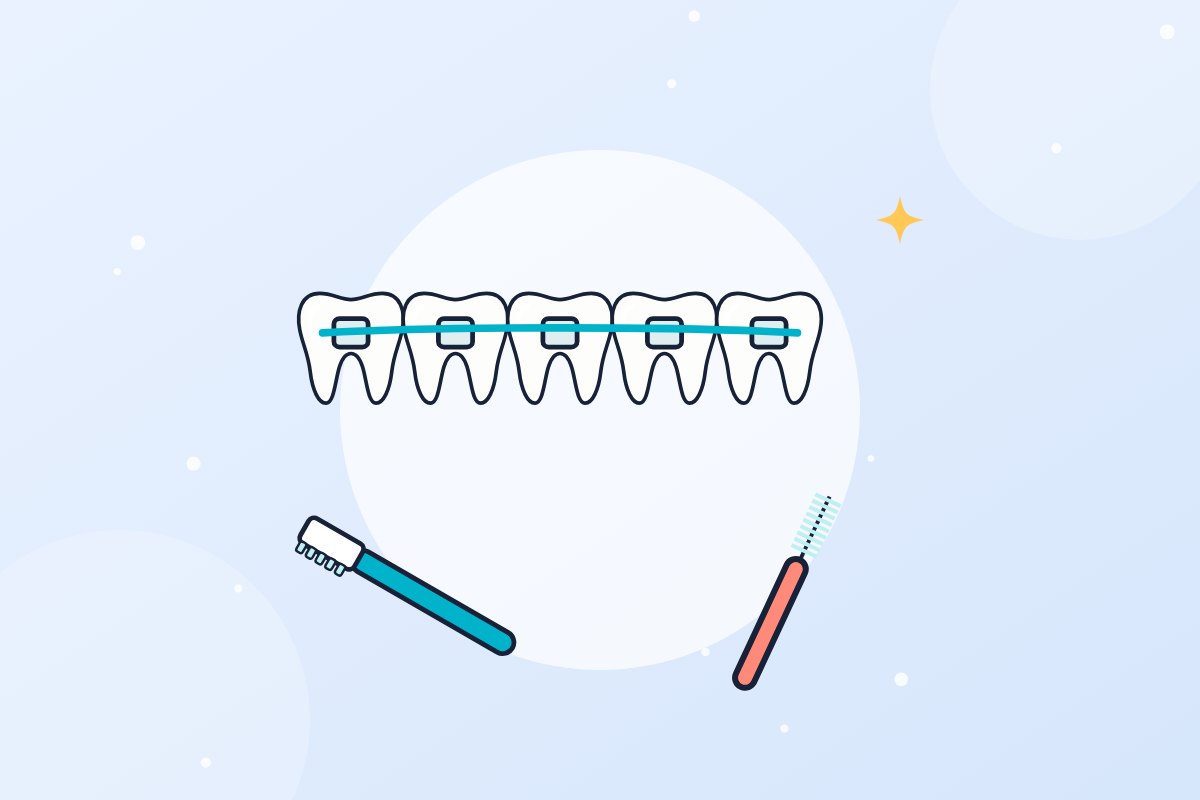
With fixed braces, brush your teeth at least twice a day with an orthodontic or electric toothbrush, and clean the areas around the brackets and under the wire with interdental brushes and floss with a stiffened end. A full clean takes 5–10 minutes.
The brackets and wire of a brace create many places where plaque builds up. Without careful hygiene, white spots of demineralised enamel and even decay can appear around the brackets. We suggest which accessories to use, how to brush and what to avoid in your diet.
- Plaque around brackets causes white spots (demineralisation) and decay.
- You need: an orthodontic or electric toothbrush, interdental brushes, floss with a stiffened end.
- After brushing, spit out the toothpaste but do not rinse with water.
- Scale and polish with braces usually every 3–4 months.
- Avoid hard and sticky foods — they can debond brackets.
Contents
- Why is hygiene harder with fixed braces?
- Which accessories do you need with fixed braces?
- How do you brush your teeth properly with braces?
- How often should you have a scale and polish during orthodontic treatment?
- What not to eat with fixed braces
- What hygiene mistakes do people with braces make?
- How much does a scale and polish with braces cost in Rydułtowy?
- Summary
- Frequently asked questions
Why is hygiene harder with fixed braces?
Brackets, wires and ligatures create many hard-to-reach places where plaque builds up. Bacteria produce acids that demineralise the enamel around the brackets — after the brace is removed, white spots become visible. Neglected hygiene also encourages decay and gum inflammation. That is why daily care during orthodontic treatment takes more time and extra accessories.
We describe how tooth decay develops in the article how tooth decay develops.
Which accessories do you need with fixed braces?
The basis is an orthodontic toothbrush with shaped bristles or an electric toothbrush, used at least twice a day. Interdental brushes are used for the areas around the brackets and under the wire, and for flossing — floss with a stiffened end that is threaded under the wire. A water flosser, plaque-disclosing tablets, and fluoride toothpaste and mouthwash are also helpful.
| Accessory | What it is for | How often |
|---|---|---|
| Orthodontic or electric toothbrush | tooth surfaces and brackets | min. twice a day |
| Interdental brushes | areas around brackets and under the wire | every day |
| Floss with a stiffened end | spaces between the teeth under the wire | every day |
| A water flosser | flushing out food debris | as a supplement |
| Disclosing tablets | checking how thoroughly you clean | e.g. once a week |
| Fluoride mouthwash | strengthening enamel | as advised by the dentist |
How do you brush your teeth properly with braces?
Hold the toothbrush at an angle of about 45° to the gumline and clean each bracket separately — from the gum side and from the biting-edge side. Then use interdental brushes to clean the spaces between the brackets and under the wire, followed by the spaces between the teeth with floss. Finally, you can use a water flosser. Spit out the toothpaste but do not rinse with water, so that the fluoride acts on the enamel for longer.
- Brush your teeth after every main meal if possible.
- A full clean usually takes 5–10 minutes.
- Replace your toothbrush more often than usual — brackets wear out the bristles faster.
How often should you have a scale and polish during orthodontic treatment?
With fixed braces, a scale and polish is usually recommended every 3–4 months — more often than for people without braces. At the appointment, tartar and stains are removed from places the toothbrush cannot reach, the condition of the gums and enamel around the brackets is assessed, and fluoride is applied. Regular appointments make it possible to catch early demineralisation before it turns into permanent marks.
Details on our pages scale and polish i fluoride treatment.
What not to eat with fixed braces
Avoid hard foods bitten whole — apples, raw carrots, nuts, hard bread crusts and biting ice cream — because sudden pressure can debond a bracket or bend the wire. Cut fruit and vegetables into small pieces. Also avoid sticky sweets such as fudge, toffee, nougat or chewing gum, which coat the brackets and are hard to remove.
| Avoid | Instead |
|---|---|
| Whole apples, raw carrots | cut into small pieces |
| Nuts, hard crunchy snacks, biting ice cream | soft snacks, ice cream eaten with a spoon |
| Crunchy bread crusts | soft bread |
| Fudge, toffee, chewing gum | sweets rarely and only with meals |
| Sugary drinks sipped throughout the day | water |
What hygiene mistakes do people with braces make?
The most common mistakes are cutting brushing down to the usual two minutes, skipping the area under the wire, not using floss and interdental brushes, and rinsing with water straight after brushing, which washes away the fluoride. Snacking on sweet things without brushing afterwards and putting off hygiene appointments until the brace comes off are also common problems.
How much does a scale and polish with braces cost in Rydułtowy?
The dentist sets how often you need hygiene appointments during treatment, depending on the condition of your gums and how effective your home hygiene is.
Current prices are listed in our price list. The final cost of treatment is set by the dentist after an examination and consultation.
Teeth cleaning and scaling
Removing tartar and stains, including around braces.
Orthodontic braces
Treating bite problems with fixed braces.
quoted after assessment
Summary
Fixed braces make hygiene harder, so they require extra accessories and more time: an orthodontic or electric toothbrush, interdental brushes, floss with a stiffened end and fluoride. It is worth avoiding hard and sticky foods and having a scale and polish every 3–4 months. That way, when the brace comes off, your teeth will be straight and free of white spots.
Frequently asked questions
What are white spots with braces?
White spots are areas of demineralised enamel around the brackets, caused by acids from plaque bacteria. They often only become visible after the brace is removed. Early changes can be partly reversed with remineralisation and fluoride; advanced ones may need treatment, e.g. resin infiltration or a filling. The best protection is thorough hygiene.
Does a water flosser replace floss with braces?
A water flosser is good at flushing food debris from under the wire and around the brackets, but it does not completely replace floss. Floss with a stiffened end cleans the contact surfaces between the teeth more effectively. A water flosser is best treated as a supplement to brushing, interdental brushes and flossing, especially for people who find flossing difficult.
How often should you replace your toothbrush with braces?
With fixed braces, it is worth replacing your toothbrush or electric brush head more often than usual, roughly every 4–6 weeks, because brackets wear out the bristles faster. Replace it straight away if the bristles start to splay. A worn toothbrush is less effective at removing plaque around the brackets, which increases the risk of white spots.
Can you chew gum with fixed braces?
Chewing gum is not recommended with fixed braces, because it can stick to the brackets and wire and be difficult to remove. Gum can also affect the ligatures and other parts of the brace. If you want to freshen your breath after a meal, it is better to rinse your mouth with water and brush your teeth as soon as you can.
Which toothpaste should you use with braces?
The most important thing is that the toothpaste contains fluoride. For people at increased risk of decay or with early demineralisation, the dentist may recommend a higher-fluoride toothpaste or additional remineralising products. Avoid highly abrasive toothpastes, which can scratch the enamel and parts of the brace. Do not rinse with water after brushing.
What should you do if a bracket comes off?
Contact the orthodontic clinic to book a repair appointment. Until then, do not try to remove or reattach the bracket yourself. If a loose part or wire irritates your cheek, cover it with orthodontic wax. Avoid hard foods, which are the most common reason brackets come off.
Sources
- American Association of Orthodontists — Caring for your braces (accessed 2026).
- Polish Orthodontic Society (Polskie Towarzystwo Ortodontyczne) — information for patients.
- Current Dobry Dentysta clinic price list.

Agnieszka Świącik, dentist
Dentist at the Dobry Dentysta practice in Rydułtowy. Medical review of this article.
Book an appointment at Dobry Dentysta in Rydułtowy
Book by phone or via the contact form. In an emergency (severe pain, injury), call us – we will tell you when we can see you.
ul. Ofiar Terroru 24, 44-280 Rydułtowy, Poland · opening hours and directions
Call: +48 575 317 617Contact form