


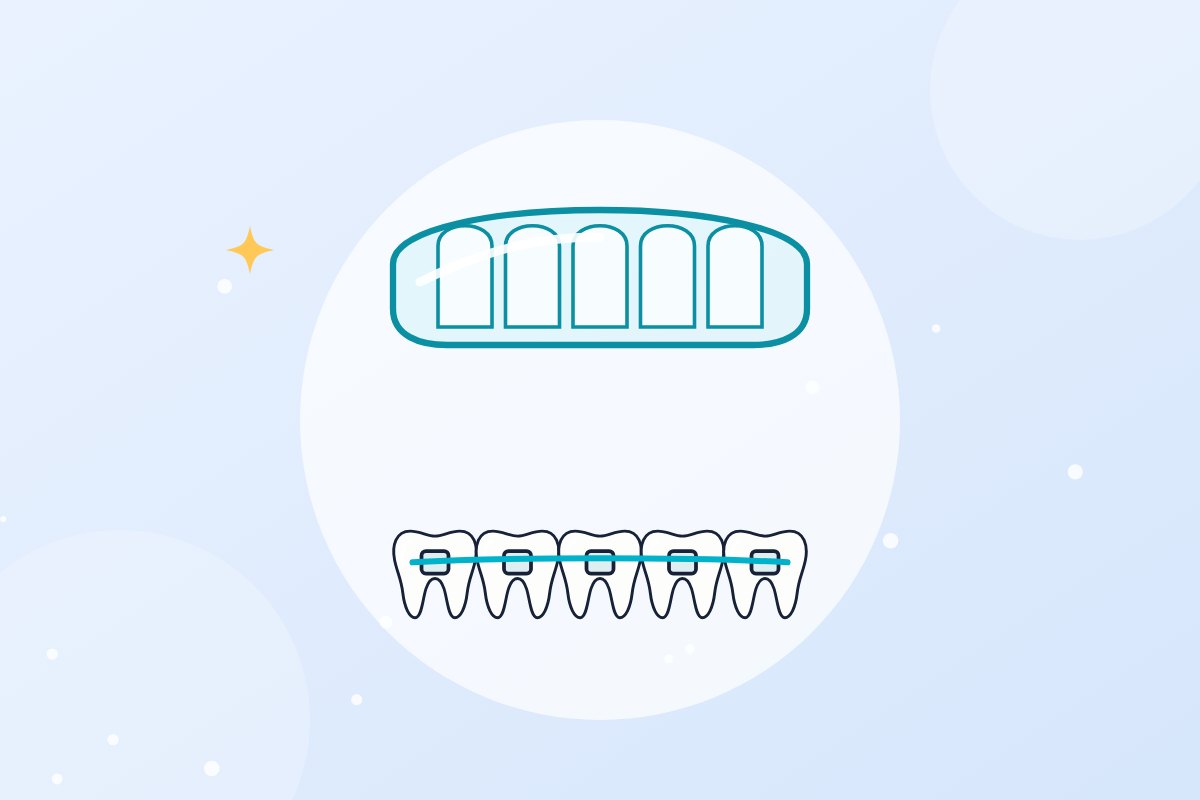
Invisalign aligners are almost invisible and removable, so eating and oral hygiene are simpler, but they have to be worn for about 22 hours a day. Fixed braces give the orthodontist full control over the movement of teeth and roots, which is why they are more often chosen for crowding over about 7 mm, skeletal problems and treatment combined with surgery. The orthodontist chooses the method after an assessment.
Choosing between clear aligners and traditional braces is one of the first questions patients ask at an orthodontic consultation. Both methods move teeth effectively, but they differ in indications, comfort and what they demand of the patient. We compare them point by point.
- Appearance: aligners are almost invisible; ceramic braces are less noticeable than metal ones.
- Complex malocclusions, skeletal problems and treatment with a surgeon — usually fixed braces.
- Aligners only work if they are worn for about 22 hours a day.
- With aligners you can eat anything and brush normally; with braces you need special brushes.
- Appointments: aligners usually every 6–8 weeks, fixed braces every 4–6 weeks.
Contents
- How does Invisalign differ from fixed braces?
- When does Invisalign work well?
- When are fixed braces the better choice?
- Which method is more comfortable day to day?
- How long does treatment take with aligners and with fixed braces?
- What mistakes do patients make when choosing a method?
- How much does orthodontic treatment cost in Rydułtowy?
- Summary
- Frequently asked questions
How does Invisalign differ from fixed braces?
Invisalign is a series of clear, removable aligners that are changed every few weeks, gradually moving the teeth. Fixed braces are brackets bonded to the teeth and an archwire that the orthodontist adjusts at appointments. Both methods move teeth and correct bite problems, but they differ in visibility, comfort, range of indications and how much depends on the patient's discipline.
| Criterion | Invisalign | Fixed braces |
|---|---|---|
| Visibility | almost invisible | visible (ceramic less so than metal) |
| Complex malocclusions | limited indications | full control of tooth movement |
| Diet | no restrictions (aligners are removable) | no hard or sticky foods |
| Hygiene | as usual, after removing the aligners | bracket brushes, floss under the wire |
| Patient discipline | essential: about 22 hours a day | braces work constantly |
| Check-up appointments | usually every 6–8 weeks | usually every 4–6 weeks |
When does Invisalign work well?
Aligners work well for mild to moderate crowding, roughly up to 6–7 mm, for gaps and diastemas, mild and moderate bite problems such as deep bite, open bite or crossbite, and for correcting relapse after previous orthodontic treatment. The condition is wearing the aligners consistently for about 22 hours a day.
You can read more about this method on our page Invisalign i invisible orthodontics.
When are fixed braces the better choice?
Fixed braces are more often chosen for severe crowding, over about 7 mm, skeletal problems requiring anchorage and treatment combined with a maxillofacial surgeon. They also work better for complex rotations and extrusions of teeth, and for patients who may find it hard to wear aligners for most of the day — braces work all the time and do not require self-discipline.
We describe the types of braces on our page orthodontic braces.
Which method is more comfortable day to day?
Day to day, aligners are usually more comfortable: you take them out to eat, so there are no dietary restrictions, and you brush your teeth as usual. With fixed braces you need to avoid hard and sticky foods and use bracket brushes and floss under the wire. The pressure after changing an aligner or adjusting braces is similar, but brackets can also irritate the cheeks and lips.
How long does treatment take with aligners and with fixed braces?
The length of treatment depends mainly on the problem being corrected, not just on the method. Short corrections with Invisalign Lite usually take 3–6 months, full Invisalign treatment 12–18 months. Fixed braces for moderate problems usually take 18–24 months. For complex cases, treatment with either method can take up to 36 months. A retainer is needed after treatment.
| Variant | Approximate time |
|---|---|
| Invisalign Lite (up to 14 aligners per arch) | 3–6 months |
| Invisalign — full treatment | 12–18 months |
| Fixed braces — moderate problems | 18–24 months |
| Complex cases (both methods) | up to 36 months |
What mistakes do patients make when choosing a method?
The most common mistake is choosing on appearance alone, without checking whether aligners can actually deal with the problem. The second is overestimating your own discipline: aligners worn for only a dozen or so hours a day will not move the teeth according to plan. The third is comparing prices alone without taking into account treatment time, the number of appointments and the cost of retention.
How much does orthodontic treatment cost in Rydułtowy?
At the Dobry Dentysta Clinic in Rydułtowy, the orthodontist gives the cost of treatment with aligners or fixed braces after an assessment, as it depends on the problem and the length of treatment.
| Service | Price |
|---|---|
| First orthodontic consultation | |
| Scans | |
| X-ray package | |
| Consultation with analysis and treatment plan | |
| Invisalign / fixed braces | quoted after assessment |
Summary
Invisalign and fixed braces both move teeth effectively, but they are not always interchangeable. Aligners win on appearance and comfort, provided they are worn for about 22 hours a day. Fixed braces give full control in complex and skeletal cases. It is best to make the final choice after a consultation, scans and X-rays, once the orthodontist has assessed what is realistic in your case.
Frequently asked questions
Is Invisalign suitable for everyone?
No. For complex malocclusions, skeletal problems, or when a patient will not wear aligners for about 22 hours a day, fixed braces are often the better choice. Aligners also require healthy teeth and gums. Whether a particular problem can be treated with aligners is assessed by the orthodontist at a consultation, based on an examination, scans and X-rays.
Does Invisalign hurt?
For 1–3 days after putting in a new aligner you feel pressure, similar to the discomfort after fixed braces are adjusted. It is usually mild and does not require painkillers. Unlike fixed braces, aligners have no brackets or wires to irritate the cheeks or lips, although the edges of an aligner sometimes take some getting used to.
How many hours a day do aligners need to be worn?
Aligners are usually worn for about 22 hours a day, taken out only for eating, drinking anything other than water, and brushing your teeth. Wearing them for less time means the teeth do not move according to plan and treatment takes longer. If you know you will find this hard to stick to, tell your orthodontist.
Can you eat everything with fixed braces?
No. With fixed braces you need to avoid hard foods such as nuts or hard sweets, and sticky ones such as toffee or chewing gum, because they can debond brackets or bend the wire. Hard fruit and vegetables are best cut into small pieces. After meals it is important to clean the brackets and the space under the wire thoroughly.
Which method is faster?
There is no single answer — the length of treatment depends mainly on the type of problem. For simple corrections, aligners can finish treatment in 3–6 months. For moderate problems, full Invisalign treatment usually takes 12–18 months and fixed braces 18–24 months. Complex cases may need up to 36 months with either method.
Do you need a retainer after Invisalign too?
Yes. After any orthodontic treatment, whatever the method, retention is needed, because teeth tend to drift back to their previous positions. This can be a fixed retainer, a thin wire bonded to the inside of the teeth, or a removable clear retainer. Wearing a retainer is best treated as an indefinite commitment.
Sources
- American Association of Orthodontists — Clear aligners vs. braces (accessed 2026).
- Align Technology — information about the Invisalign system (invisalign.com, accessed 2026).
- Rossini G. et al., Efficacy of clear aligners in controlling orthodontic tooth movement: a systematic review, Angle Orthod, 2015.
- Current Dobry Dentysta clinic price list.
Current prices are listed in our price list. The final cost of treatment is set by the dentist after an examination and consultation.

Agnieszka Świącik, dentist
Dentist at the Dobry Dentysta practice in Rydułtowy. Medical review of this article.
Book an appointment at Dobry Dentysta in Rydułtowy
Book by phone or via the contact form. In an emergency (severe pain, injury), call us – we will tell you when we can see you.
ul. Ofiar Terroru 24, 44-280 Rydułtowy, Poland · opening hours and directions
Call: +48 575 317 617Contact form