

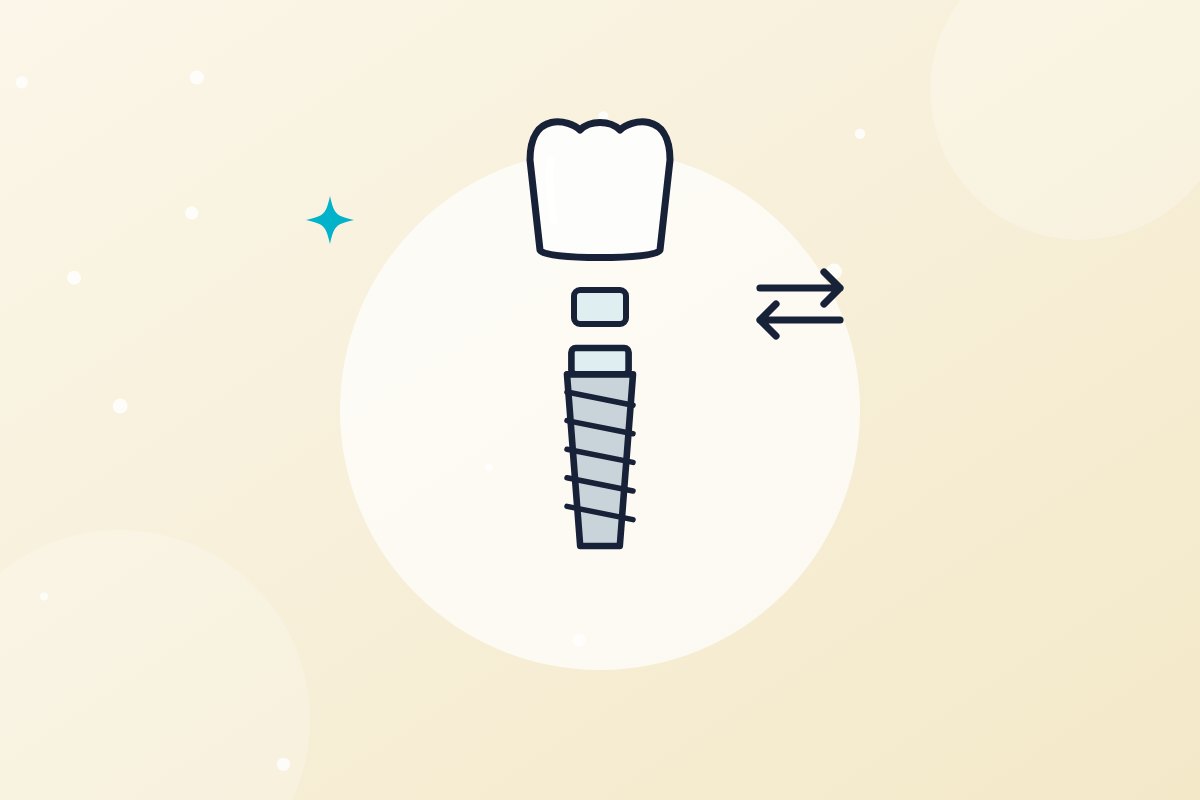
A dental implant consists of three parts: a titanium screw placed in the bone (an artificial root), a connector known as the abutment, and a ceramic or zirconia crown. The screw is usually 8–16 mm long and 3.5–6 mm in diameter. The crown is fitted after osseointegration – the fusion of the implant with the bone – which usually takes 2–4 months in the lower jaw and 4–6 months in the upper jaw.
The word “implant” usually brings to mind a whole artificial tooth, but in fact it is only one of the three parts of the restoration. We explain what an implant is made of, why it is made of titanium and why you have to wait several months for the crown.
- Implant restoration = screw (implant) + connector (abutment) + crown.
- The screw is titanium: biocompatible, corrosion-resistant and fuses well with bone.
- Typical screw dimensions: 8–16 mm long, 3.5–6 mm in diameter.
- Osseointegration: usually 2–4 months in the lower jaw, 4–6 months in the upper jaw.
- An implant shows up clearly on X-rays – follow-up imaging lets the dentist check the bone around it.
Contents
- What is a dental implant?
- What parts does an implant consist of?
- Why are implants made of titanium?
- How is an implant screw constructed?
- Why do you have to wait several months for the crown?
- Is an implant visible on an X-ray?
- When can an implant not be placed straight away?
- How much does a dental implant cost in Rydułtowy?
- Summary
- Frequently asked questions
What is a dental implant?
A dental implant is a titanium screw surgically placed in the upper or lower jawbone to replace the root of a lost tooth. Once it has healed in, an abutment and a prosthetic crown are attached to it. Together they form a restoration that recreates both the visible part and the root of the tooth, so chewing forces are transferred to the bone much as with a natural tooth.
Implants can replace a single tooth, several teeth (e.g. an implant bridge) or stabilise a denture. Read more about the treatment on the page dental implants.
What parts does an implant consist of?
A complete implant restoration has three components. The titanium implant screw (fixture) sits in the bone and acts as the root. The abutment, made of titanium or zirconia, stock or custom-designed, connects the screw to the crown. The ceramic or zirconia crown is the visible part of the tooth, matched in colour and shape to the neighbouring teeth.
| Element | Material | Function |
|---|---|---|
| Implant screw (fixture) | titanium | artificial root anchored in the bone |
| Connector (abutment) | titanium, zirconia; stock or custom | connects the implant to the crown |
| Crown | ceramic, zirconia | visible part of the tooth, chewing and aesthetics |
Read about crowns on the page implant crowns.
Why are implants made of titanium?
Titanium is biocompatible, corrosion-resistant and very rarely causes hypersensitivity reactions. Above all, it osseointegrates – bone cells grow directly onto its surface, so the implant fuses firmly with the bone. It has been the standard material in implantology for decades. In selected cases, ceramic implants made of zirconium oxide are also used.
How is an implant screw constructed?
The screw is usually 8–16 mm long and 3.5–6 mm in diameter – the dimensions are chosen to match the height and width of the bone. Its surface is roughened, e.g. sandblasted and acid-etched, which increases the contact area with bone and promotes osseointegration. The head of the screw has an internal connection into which the abutment is screwed. A CBCT scan is used to plan the dimensions.
Thanks to the three-dimensional image, the dentist can assess the amount of bone and the position of important structures such as the nerve or the maxillary sinus. More on the page CBCT scan.
Why do you have to wait several months for the crown?
After placement, the implant has to fuse with the bone – this is osseointegration. It usually takes 2–4 months in the lower jaw and 4–6 months in the upper jaw, where the bone is more porous. Only then can the implant be safely loaded with a crown. With very good primary stability, immediate loading with a temporary crown is possible in selected cases, but not for every patient.
| Stage | Approximate time |
|---|---|
| Implant placement | one surgical visit |
| Osseointegration – lower jaw | 2–4 months |
| Osseointegration – upper jaw | 4–6 months |
| Abutment and crown | after healing is complete |
Is an implant visible on an X-ray?
Yes, an implant shows up clearly on an X-ray. A panoramic X-ray or CBCT scan shows the screw and its position relative to the bone and neighbouring teeth, and after restoration also the abutment and crown. Follow-up X-rays allow the bone level around the implant to be assessed; the dentist decides how often they are needed, usually every one or two years.
When can an implant not be placed straight away?
Implant placement requires enough bone and a healthy mouth. The procedure is postponed if there is untreated decay or active gum disease, and if there is too little bone, bone grafting may be needed first. Smoking and poorly controlled diabetes, among other things, increase the risk of failure. The dentist makes the final decision after an examination and a CBCT scan.
How much does a dental implant cost in Rydułtowy?
At Dobry Dentysta in Rydułtowy the cost of an implant is quoted individually, because it depends on the implant system, the type of abutment and crown and any bone grafting. The dentist presents a treatment plan with a cost estimate after the examination.
| Service | Price |
|---|---|
| Surgical consultation | |
| Panoramic X-ray | |
| CBCT small field / partial / full | |
| Implant, abutment, crown | individual quote |
Summary
An implant restoration consists of a titanium screw, an abutment and a crown. Titanium fuses well with bone, so after placement several months of osseointegration are usually needed before the implant is loaded with a crown. The implant dimensions are chosen based on a CBCT scan, and long-term success depends on bone health, hygiene and regular check-ups.
Frequently asked questions
How much does a dental implant weigh?
The implant screw itself usually weighs less than a gram, because titanium is a light metal and the implant is small. Once healed in, patients do not feel the implant as a foreign body – the restoration works much like a natural tooth. The weight of the crown and abutment is not noticeable in everyday use either.
Will an implant set off airport security?
Dental implants usually do not trigger security gates, because they are small and titanium is only weakly detected by standard metal detectors. In practice, patients with implants pass through security without problems. You do not need to carry a certificate, although you can tell the staff about your implants if in doubt.
Can an implant fail to integrate?
Yes, although it is rare – in studies the success rate of implant treatment is usually above 95%. If the implant does not fuse with the bone, it is removed and, after healing, usually a few months later, a new implant can be considered. Smoking, uncontrolled diabetes and poor hygiene, among other things, increase the risk.
Can you be allergic to titanium?
Titanium hypersensitivity is very rare. Titanium is one of the best-tolerated materials used in medicine. If a patient has a documented metal allergy or concerns about it, it is worth discussing with the dentist – in selected cases ceramic implants made of zirconium oxide can be used.
Can you have an MRI scan with a dental implant?
Titanium implants are not ferromagnetic and usually do not prevent an MRI scan. They can, however, cause local artefacts in the image around the face. Before the scan, tell the imaging staff about your implants and any other metal in your mouth; the decision rests with the referring doctor or radiologist.
How long does a dental implant last?
A properly integrated implant can last many years with good hygiene and regular check-ups. The crown on the implant may need replacing over time, as it wears like any prosthetic restoration. Longevity is affected by gum health, smoking, bruxism and the patient’s general health, among other things.
Sources
- International Team for Implantology (ITI) – Treatment Guides and consensus statements (accessed 2026).
- Albrektsson T. et al., The long-term efficacy of currently used dental implants, Int J Oral Maxillofac Implants, 1986.
- Current Dobry Dentysta clinic price list.
Current prices are listed in our price list. The final cost of treatment is set by the dentist after an examination and consultation.

Agnieszka Świącik, dentist
Dentist at the Dobry Dentysta practice in Rydułtowy. Medical review of this article.
Book an appointment at Dobry Dentysta in Rydułtowy
Book by phone or via the contact form. In an emergency (severe pain, injury), call us – we will tell you when we can see you.
ul. Ofiar Terroru 24, 44-280 Rydułtowy, Poland · opening hours and directions
Call: +48 575 317 617Contact form