

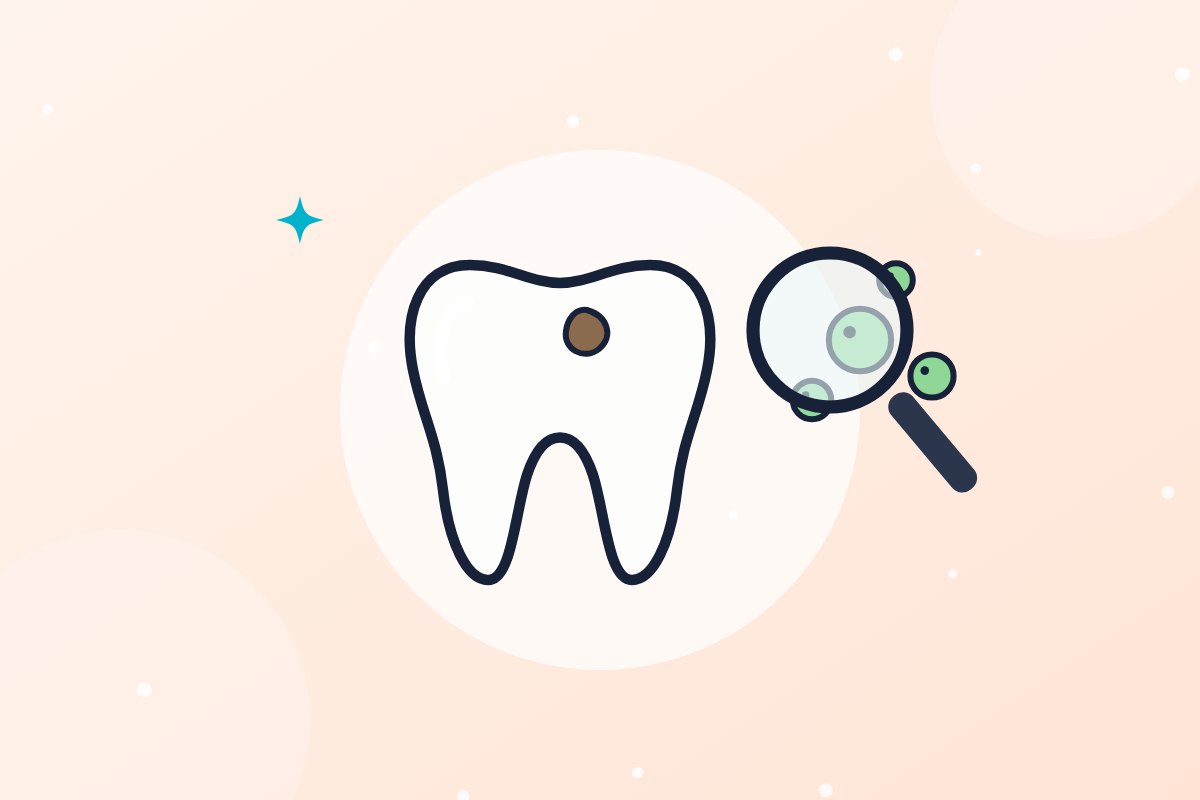
Tooth decay develops when plaque bacteria turn sugars into acids that dissolve enamel over time. At the white, chalky spot stage it is reversible — fluoride, less frequent snacking and fluoride treatment help. Once a cavity forms, a filling is needed, and when the infection reaches the pulp — usually root canal treatment.
Tooth decay is one of the most common diseases in the world, yet it is still often treated as bad luck or ‘weak teeth inherited from your parents’. In fact it has a well-understood bacterial mechanism that can be interrupted at an early stage. We explain how it develops, how it hurts and what to do to stop it.
- Decay requires four factors: bacteria, sugars, a susceptible tooth and time.
- A white spot (demineralisation) is reversible; a cavity is not.
- Pain only appears when decay reaches the dentine or the pulp.
- Severe pain easing off may mean the pulp has died, not that it has healed.
- Early changes are best detected by an examination with bitewing X-rays.
Contents
- What is tooth decay?
- What factors cause tooth decay?
- How does decay progress and when does it start to hurt?
- How can decay be stopped at an early stage?
- How does a dentist detect decay?
- What mistakes encourage tooth decay?
- How much does treating tooth decay cost in Rydułtowy?
- Summary
- Frequently asked questions
What is tooth decay?
Tooth decay (dental caries) is a bacterial disease of the hard tissues of the tooth, in which acids produced by plaque bacteria dissolve the enamel and then the dentine. Destroyed tissue does not rebuild itself — enamel contains no living cells. However, the early phase, before a cavity forms, can be stopped and reversed, which is why dentistry puts so much emphasis on prevention.
What factors cause tooth decay?
Decay develops when four factors act at the same time: cariogenic bacteria in plaque (including Streptococcus mutans and Lactobacillus), fermentable sugars, a susceptible tooth — e.g. deep fissures or weaker enamel — and the length of time acid is in contact with the enamel. This is known as Keyes' model. Limiting even one of these factors significantly reduces the risk of decay.
| Factor | Examples | How to limit it |
|---|---|---|
| Bacteria (plaque) | S. mutans, Lactobacillus | brushing twice a day, floss or interdental brushes |
| Sugars | sweets, juices, bread, dried fruit | less frequent snacking, sweet things only with meals |
| Tooth susceptibility | deep fissures, weaker enamel | fluoride toothpaste, fluoride treatment, fissure sealing |
| Time | sipping sugary drinks | short contact between sugar and teeth |
We write about how food affects teeth in the article diet and dental health.
How does decay progress and when does it start to hurt?
The first stage is demineralisation — a chalky white spot on the enamel that does not hurt and is reversible. Then the enamel breaks down and a cavity forms. When decay reaches the dentine, sensitivity to sweet, cold and hot appears. Infection of the pulp causes severe, spontaneous pain, often at night. The pulp dying may bring relief, but the infection then spreads to the bone.
| Stage | Symptoms | Typical treatment |
|---|---|---|
| White spot (demineralisation) | no pain, chalky spot | remineralisation, fluoride |
| Cavity in the enamel | usually no pain | small filling |
| Decay in the dentine | pain in response to stimuli, which stops when they are removed | filling |
| Pulpitis | severe, spontaneous, throbbing pain, often at night | root canal treatment |
| Dead pulp | pain may subside; risk of abscess | root canal treatment or extraction |
How can decay be stopped at an early stage?
At the white spot stage, decay can be reversed through remineralisation. The basis is fluoride toothpaste — fluoride is incorporated into the enamel and makes it more resistant to acids. With increased risk, the dentist may recommend CPP-ACP products and fluoride treatment at the clinic. Reducing how often you snack is just as important: several ‘sugar attacks’ a day do more harm than one dessert after lunch.
You can read more about the procedure on our pages fluoride treatment i preventive dentistry.
How does a dentist detect decay?
Early decay, especially on the contact surfaces between teeth, can be invisible to the naked eye. That is why an examination combines looking at the teeth with X-ray diagnostics — bitewing and single-tooth X-rays make it possible to detect lesions hidden beneath the enamel. Fluorescence methods and intraoral cameras are used as a supplement. The dentist adjusts how often X-rays are taken to your individual risk of decay.
Details on our pages dental check-up i X-ray diagnostics.
What mistakes encourage tooth decay?
The most common mistakes are snacking and sipping sugary drinks throughout the day, skipping brushing in the evening, not cleaning between the teeth and putting off check-ups because ‘nothing hurts’. It is also dangerous to assume that pain has gone away by itself — with decay this often means the pulp has died. Do not lick a child's dummy or spoon.
How much does treating tooth decay cost in Rydułtowy?
Current prices are listed in our price list. The final cost of treatment is set by the dentist after an examination and consultation.
Summary
Decay develops gradually — from a reversible white spot, through a cavity, to infection of the pulp. At an early stage it can be stopped with fluoride, changes in habits and fluoride treatment, while a cavity needs a filling. Because early decay does not hurt, regular check-ups and X-rays are key, as they allow it to be detected before root canal treatment is needed.
Frequently asked questions
Why does tooth decay not hurt at first?
Enamel has no nerves, so early decay causes no pain. Discomfort only appears when bacteria reach the dentine, and severe pain when they reach the pulp. That is why regular check-ups and X-rays are so important — they make it possible to detect changes that are invisible to the naked eye and still painless.
Is tooth decay contagious?
Decay-causing bacteria such as Streptococcus mutans can be passed on in saliva — through shared cutlery or by licking a child's dummy or spoon. However, the mere presence of bacteria does not mean decay; diet, hygiene and fluoride also play a role. That is why parents are advised not to taste their child's food with the child's spoon and not to lick the dummy.
What is secondary decay?
Secondary decay develops at the edge of or beneath an existing filling, usually where plaque builds up or the seal has failed. It is one of the common reasons for replacing fillings. It may not be visible when looking at the teeth, so X-rays are helpful. Early detection helps avoid infection of the pulp.
Does a white spot on a tooth need drilling?
Usually not. A chalky white spot is early demineralisation of the enamel, which can be stopped and reversed through remineralisation — with fluoride toothpaste, fluoride treatment at the clinic, calcium-phosphate products and changes in habits. The dentist monitors such a spot at subsequent appointments. A filling is only needed once the enamel breaks down and a cavity forms.
How often should X-rays be taken to check for decay?
The dentist adjusts how often X-rays are taken to your individual risk of decay. For people at low risk, bitewing X-rays are taken less often, usually every 1–2 years, and more often for people with many cavities or new lesions. Dental X-rays taken with modern digital equipment involve a low radiation dose.
Can tooth decay stop on its own?
At the white spot stage — yes, if hygiene and diet improve and the enamel gets fluoride. Once a cavity forms, the tissue does not rebuild itself and decay usually progresses. Arrested lesions, dark and hard, do occur, but only a dentist can assess them during an examination.
Sources
- World Health Organization — Global oral health status report, 2022.
- Pitts N.B. et al., Dental caries, Nature Reviews Disease Primers, 2017.
- Polish Society of Paediatric Dentistry (Polskie Towarzystwo Stomatologii Dziecięcej) — recommendations on fluoride prevention.
- Current Dobry Dentysta clinic price list.

Agnieszka Świącik, dentist
Dentist at the Dobry Dentysta practice in Rydułtowy. Medical review of this article.
Book an appointment at Dobry Dentysta in Rydułtowy
Book by phone or via the contact form. In an emergency (severe pain, injury), call us – we will tell you when we can see you.
ul. Ofiar Terroru 24, 44-280 Rydułtowy, Poland · opening hours and directions
Call: +48 575 317 617Contact form