



Yes — there is no upper age limit for orthodontic treatment. In adults the bone is mature, so treatment usually takes longer than in children: simple corrections 3–8 months, moderate problems 12–18 months, complex cases 24–36 months. The options are Invisalign aligners and fixed metal, ceramic or lingual braces. A retainer is essential after treatment, ideally worn indefinitely.
More and more people decide to straighten their teeth only as adults — because it was not an option in childhood, because the problem came back, or because treatment is needed before prosthetic restoration. We explain how treating adults differs from treating children, what the methods are and how long it takes.
- There is no upper age limit for orthodontics.
- In adults treatment usually takes longer, and skeletal problems may require working with a surgeon.
- Methods: Invisalign aligners, metal, ceramic or lingual braces.
- Time: from 3–8 months (simple corrections) to 24–36 months (complex cases).
- After treatment, a retainer — ideally indefinitely.
Contents
- Can adults have orthodontic treatment?
- Why do adults choose orthodontics?
- What orthodontic treatment options are available for adults?
- Why do adults often choose Invisalign?
- How long does orthodontic treatment take in adults?
- Do you need to wear a retainer after orthodontic treatment?
- When does orthodontic treatment need to be postponed?
- How much does an orthodontic consultation cost in Rydułtowy?
- Summary
- Frequently asked questions
Can adults have orthodontic treatment?
Yes, there is no upper age limit for orthodontic treatment. The difference is that in an adult the bone is fully mature and no longer growing, so moving teeth usually takes longer, and some skeletal problems require working with a maxillofacial surgeon. The most common problems — crowding, rotated individual teeth and gaps — are treated successfully in adults.
Healthy teeth and gums are a precondition for starting treatment. Before braces or aligners are fitted, decay and gum inflammation need to be treated — which is why orthodontic treatment is usually preceded by a check-up and a scale and polish.
Why do adults choose orthodontics?
The reasons vary. Some patients did not have access to treatment as children; in others the problem came back because they did not wear a retainer after their first treatment. Often it is about the appearance of the smile, but there are also prosthetic reasons — straightening teeth before an implant or bridge — and health reasons, when the bite contributes to overloading of the jaw joints or tooth wear.
- Appearance — crowding, gaps, crooked front teeth.
- Relapse — after earlier treatment without retention.
- Prosthetic preparation — space for an implant or bridge.
- Function — overloading of the jaw joint, tooth wear, difficulty keeping teeth clean.
What orthodontic treatment options are available for adults?
Adults can choose between removable Invisalign aligners and fixed braces: metal, ceramic with tooth-coloured brackets, and lingual, fitted to the inner surfaces of the teeth. The methods differ in visibility, comfort and the range of problems they can treat. The orthodontist decides after an examination and analysis of photos and scans — not every method suits every problem.
| Method | Visibility | Removable | Notes |
|---|---|---|---|
| Invisalign aligners | almost invisible | yes | must be worn for most of the day; no dietary restrictions |
| Fixed metal braces | visible | no | also used for complex cases |
| Fixed ceramic braces | less noticeable | no | tooth-coloured brackets |
| Lingual braces | invisible from the outside | no | require careful hygiene |
Details: orthodontic braces, invisible orthodontics.
Why do adults often choose Invisalign?
Invisalign aligners are clear and hard to notice in conversation, and they can be taken out for meals and important occasions. There are no dietary restrictions, and hygiene is simpler than with fixed braces — you just take the aligner out and brush your teeth as usual. Check-ups are usually every 6–8 weeks, compared with every 4–6 weeks for fixed braces.
Discipline is the condition for success: aligners only work if they are worn for most of the day. You can read more about this method on our page Invisalign.
How long does orthodontic treatment take in adults?
The length of treatment depends on the type and complexity of the problem. Simple corrections, e.g. with Invisalign Lite or braces covering only the front teeth, usually take 3–8 months. Moderate problems need 12–18 months, and complex cases, especially skeletal problems treated with surgery, 24–36 months. The orthodontist gives an approximate timeline after the consultation and analysis.
| Type of problem | Approximate treatment time |
|---|---|
| Simple corrections (front teeth) | 3–8 months |
| Moderate problems | 12–18 months |
| Complex, skeletal problems | 24–36 months |
| Finishing before/after prosthetic treatment | 6–12 months |
Do you need to wear a retainer after orthodontic treatment?
Yes, retention is needed after any orthodontic treatment. Teeth tend to drift back to their previous positions, so without protection the result gradually reverses. A retainer can be fixed — a thin wire bonded to the inside of the teeth — or removable, in the form of a clear splint. The safest approach is to treat wearing a retainer as an indefinite commitment.
When does orthodontic treatment need to be postponed?
Treatment is not started with untreated decay, active gum or periodontal inflammation, or poor oral hygiene — braces in these conditions increase the risk of cavities and bone loss. The teeth must be treated and the gums stabilised first. Aligners are also unsuitable for people who cannot wear them for most of the day.
How much does an orthodontic consultation cost in Rydułtowy?
The cost of the treatment itself depends on the method and the complexity of the problem — the orthodontist gives it after the analysis.
Current prices are listed in our price list. The final cost of treatment is set by the dentist after an examination and consultation.
Orthodontic braces
Fixed braces for treating various bite problems.
quoted after assessment
Summary
Orthodontic treatment for adults is possible at any age and can improve the appearance of the smile and the function of the bite, as well as preparing teeth for prosthetic treatment. It usually takes longer than in children, and the method — Invisalign aligners or fixed braces — depends on the problem and the patient's expectations. Healthy teeth and gums are a precondition, and a retainer is essential afterwards.
Frequently asked questions
Does orthodontic treatment hurt for adults?
After braces are fitted and after adjustment appointments, you feel pressure and mild tooth discomfort for 2–4 days. Over-the-counter painkillers taken as directed on the leaflet usually help. Over time the teeth get used to the forces, and the discomfort after each appointment becomes less. With aligners, pressure usually appears after changing to a new set.
Can orthodontic treatment damage the gums?
With good hygiene, orthodontic treatment does not harm the gums, and properly aligned teeth are easier to clean, which supports gum health. Problems arise when hygiene is neglected, especially with fixed braces. That is why inflammation must be treated before treatment, and tartar and plaque removed regularly during it.
Where do you start with orthodontic treatment as an adult?
The first step is an orthodontic consultation. The orthodontist will assess the condition of your teeth, gums and bite, and then present the possible treatment methods and an approximate timeline. Planning treatment usually requires scans, photos and X-rays — a panoramic and a cephalometric X-ray. The appointment usually takes 30–45 minutes.
Is there an upper age limit for braces?
There is no upper age limit. What matters is the condition of the teeth, gums and bone, not your date of birth. In older patients, treatment is often part of a wider plan, e.g. before prosthetic restoration. Decay and gum disease must be treated first, and careful hygiene and regular check-ups are needed during treatment.
Which is less visible: Invisalign or ceramic braces?
Invisalign aligners are clear and hard to notice, and they can also be taken out for important occasions. Ceramic braces have tooth-coloured brackets, so they are less noticeable than metal ones, but they stay on the teeth permanently. Lingual braces are completely invisible from the outside. The choice also depends on the type of problem.
How long do you wear a retainer?
A retainer is best treated as an indefinite commitment, because teeth tend to drift back to their previous positions throughout life. A fixed retainer is a thin wire bonded to the tongue side of the teeth; a removable one is a clear splint, usually worn at night as advised by the orthodontist. Regular check-ups make it possible to confirm that retention is working properly.
Sources
- American Association of Orthodontists — Adult orthodontics (accessed 2026).
- Polish Orthodontic Society (Polskie Towarzystwo Ortodontyczne) — information for patients.
- Current Dobry Dentysta clinic price list.
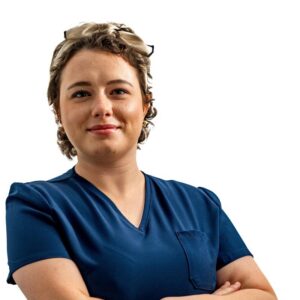
Agnieszka Świącik, dentist
Dentist at the Dobry Dentysta practice in Rydułtowy. Medical review of this article.
Book an appointment at Dobry Dentysta in Rydułtowy
Book by phone or via the contact form. In an emergency (severe pain, injury), call us – we will tell you when we can see you.
ul. Ofiar Terroru 24, 44-280 Rydułtowy, Poland · opening hours and directions
Call: +48 575 317 617Contact form