


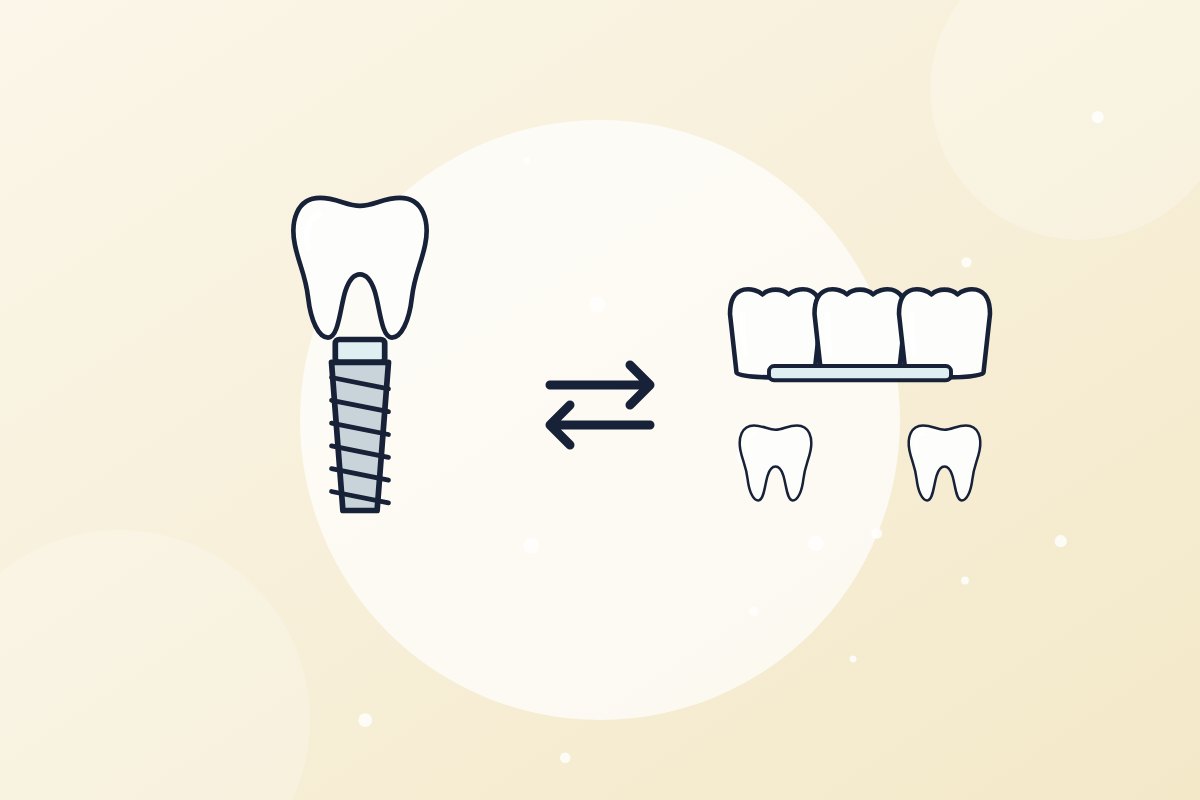
Choose an implant if the teeth next to the gap are healthy and you want to stop bone loss where the tooth was lost – treatment usually takes 3–6 months. Choose a bridge if the neighbouring teeth need crowns anyway or you want a shorter treatment, usually 2–4 weeks. The dentist makes the decision after an examination and an X-ray or CBCT scan.
Below you will find a comparison table covering six criteria, how each method works, a look at long-term costs, contraindications for implants and answers to patients’ most common questions.
- Implant: usually 3–6 months of treatment (healing into the bone), procedure under local anaesthetic.
- Bridge: usually 2–4 weeks, no surgery, but 2 abutment teeth have to be prepared.
- A conventional bridge usually needs replacing after 10–15 years; with good hygiene an implant can last considerably longer.
- The first step is a prosthodontic or surgical consultation, often with a CBCT scan (see our price list).
- At Dobry Dentysta the price of an implant or bridge is quoted individually after a consultation.
Contents
- How does an implant differ from a bridge?
- Implant or bridge – a comparison across 6 criteria
- What happens to the bone after tooth loss?
- How much does an implant cost compared with a bridge?
- How long does treatment with an implant or bridge take?
- Who cannot have an implant?
- Summary
- Frequently asked questions
How does an implant differ from a bridge?
An implant is a titanium screw placed in the upper or lower jawbone which, once healed in (osseointegrated), replaces the tooth root and supports a crown. A dental bridge is a fixed restoration resting on the two neighbouring teeth (abutments): they are prepared and covered with crowns, and a replacement tooth is suspended between them. An implant replaces one tooth independently, while a bridge “borrows” support from its neighbours.
Both options are fixed and look natural if the crown is well made. They differ, however, in how much they affect healthy teeth, how long treatment takes and what happens to the bone where the tooth is missing. We describe how an implant is built step by step in the article what a dental implant is made of.
Implant or bridge – a comparison across 6 criteria
The key differences concern the healthy neighbouring teeth, the bone and treatment time. An implant does not require the teeth next to the gap to be prepared and limits bone loss, but it involves surgery and several months of healing. A bridge is quicker and needs no surgery, but it means irreversibly preparing two teeth and does not protect the bone under the pontic.
| Criterion | Implant | Dental bridge |
|---|---|---|
| Effect on neighbouring teeth | none | preparation of 2 abutment teeth |
| Treatment time | usually 3–6 months | usually 2–4 weeks |
| Surgery | yes, under local anaesthetic | no |
| Effect on bone | limits bone loss | does not prevent bone loss under the pontic |
| Durability | many years with good hygiene | usually 10–15 years, then replacement |
| Hygiene | as with a natural tooth | harder under the pontic (superfloss, water flosser) |
Approximate values – in each case the dentist determines the timing and course of treatment after an examination.
What happens to the bone after tooth loss?
Without a tooth root, the bone in the gap gradually shrinks (resorption), because it is no longer loaded during chewing. This happens fastest in the first year after tooth loss. An implant transfers chewing forces to the bone much like a natural root, helping to maintain its volume. A bridge does not – the bone under the pontic continues to shrink.
Bone loss has practical consequences: the longer a gap is left unfilled, the greater the risk that bone grafting (augmentation) will be needed before an implant can be placed. This prolongs treatment and increases its cost. That is why it is worth deciding within a few months of losing a tooth.
How much does an implant cost compared with a bridge?
At Dobry Dentysta the price of an implant or bridge is quoted individually after a consultation, because it depends on the number of missing teeth, the condition of the bone and the type of crown.
A bridge has a lower initial cost, but a conventional bridge usually needs replacing after 10–15 years, which means new prosthetic work and preparing the abutment teeth again. An implant costs more up front, but with good hygiene it does not need replacing for many years, so over 20–25 years the difference in total cost often narrows. We write more about the factors affecting price in the article how much does a dental implant cost.
Dental implants
For people with healthy teeth next to the gap and enough bone.
Treatment: usually 3–6 months
Price: quote after consultation
Dental bridges
When the abutment teeth need crowns anyway or an implant is contraindicated.
Treatment: usually 2–4 weeks
Price: quote after consultation
How long does treatment with an implant or bridge take?
A dental bridge is usually made in 2–4 weeks over several visits: preparation of the abutment teeth and a scan, a try-in and then fitting of the bridge. Implant treatment usually takes 3–6 months, as that is how long the implant needs to heal into the bone. Only after this time is the final crown fitted on the implant.
- Implant: consultation and CBCT scan → implant placement under local anaesthetic → healing period (usually 3–6 months) → uncovering the implant and scan → fitting the crown.
- Bridge: consultation → preparation of abutment teeth and scan → temporary crown or bridge → fitting the final bridge.
In some situations a temporary crown can be fitted on the implant on the day of surgery. The dentist decides whether this protocol is safe after assessing the bone.
Who cannot have an implant?
An implant is not possible or requires preparation if there is not enough bone at the site, if the patient has uncontrolled diabetes or active gum disease. Smoking, which impairs healing, also clearly increases the risk of failure. In such situations the solution is often preparatory treatment first, or choosing a bridge.
- Insufficient bone – grafting is possible, but it prolongs treatment and increases the cost.
- Uncontrolled diabetes – blood sugar must be stabilised before surgery, because high glucose levels impair healing.
- Active periodontitis – must be treated first; see periodontitis – symptoms and treatment.
- Smoking – reduces the chances of the implant healing in properly.
If an implant still fails to heal in, retreatment is possible – we describe this in the article implant failure – what next.
Summary
An implant is the better choice when the neighbouring teeth are healthy and there is enough bone – treatment usually takes 3–6 months, but it protects the bone and leaves the neighbouring teeth untouched. A bridge works well when the teeth next to the gap need crowns anyway or an implant is contraindicated, and treatment has to be completed within 2–4 weeks. The dentist sets the final plan and cost after a consultation.
Frequently asked questions
Is an implant worth the higher price compared with a bridge?
In many cases yes, especially over 20–25 years. An implant does not require healthy teeth to be prepared, helps preserve bone and, with good hygiene, does not need replacing, whereas a conventional bridge is usually replaced after 10–15 years. Ultimately, cost-effectiveness depends on the individual patient’s situation.
Does implant placement hurt?
The procedure itself is carried out under local anaesthetic, so the patient feels pressure but no pain. For a few days afterwards there may be swelling and tenderness, which usually respond to ordinary painkillers. Computer-controlled anaesthesia is also available at the clinic, which reduces the discomfort of the injection itself.
Does a bridge damage the abutment teeth?
A bridge does not damage the teeth immediately, but it requires part of their tissue to be permanently removed for the crowns. Such teeth are later more prone to decay at the crown margin and to needing root canal treatment. That is why an implant is often considered first when the neighbouring teeth are completely healthy.
How many visits does an implant need compared with a bridge?
A bridge usually needs 2–4 visits spread over a few weeks. Implant treatment most often means 4–6 visits over several months: a consultation with CBCT, the placement procedure, a healing check, a scan and fitting the crown. The dentist presents the exact visit plan after the consultation.
Do I have to decide straight away after losing a tooth?
You do not have to decide on the same day, but it is not worth waiting many months. Bone in the gap shrinks fastest in the first year and neighbouring teeth may drift towards the gap. The sooner you decide, the better the chance of an implant without bone grafting.
Can someone over 60 have an implant?
Yes, age in itself is not a contraindication to an implant. What matters is general health, the amount of bone, medication and chronic conditions such as diabetes or osteoporosis. The dentist decides after taking a medical history and a CBCT scan. More in our article on dental care for older adults.
Sources
- Polish Implantology Society (Polskie Towarzystwo Implantologiczne) – patient materials (accessed 2026).
- American Dental Association, “Dental Implants”, MouthHealthy (accessed 2026).
- Schropp L. et al., Bone healing and soft tissue contour changes following single-tooth extraction, Int J Periodontics Restorative Dent, 2003.
Current prices are listed in our price list. The final cost of treatment is set by the dentist after an examination and consultation.

Agnieszka Świącik, dentist
Dentist at the Dobry Dentysta practice in Rydułtowy. Medical review of this article.
Book an appointment at Dobry Dentysta in Rydułtowy
Book by phone or via the contact form. In an emergency (severe pain, injury), call us – we will tell you when we can see you.
ul. Ofiar Terroru 24, 44-280 Rydułtowy, Poland · opening hours and directions
Call: +48 575 317 617Contact form