

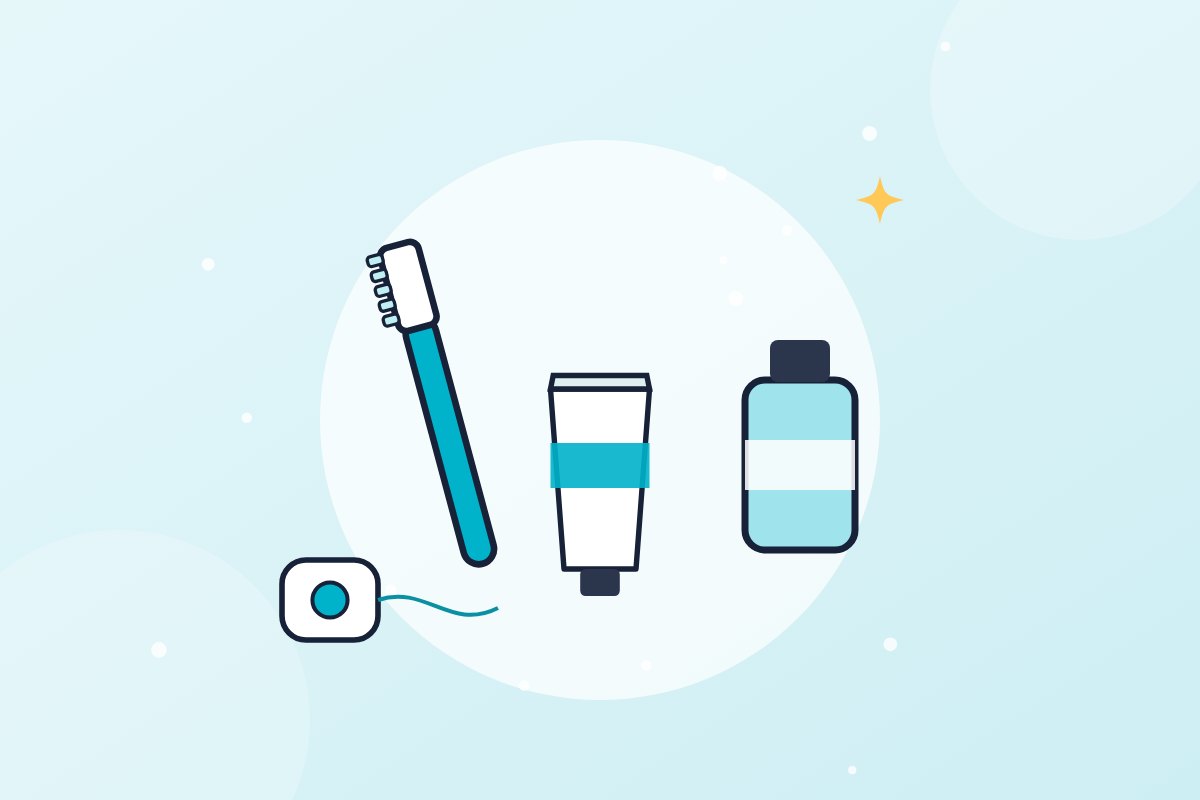
Good oral hygiene at home means brushing your teeth twice a day for at least 2 minutes with a fluoride toothpaste (1450 ppm for adults), cleaning between your teeth with floss once a day and replacing your toothbrush every 3 months. This is complemented by a dental check-up and a scale and polish at the clinic about every 6 months.
Below we describe step by step how to brush and floss, how to choose a toothbrush, toothpaste and water flosser, the most common mistakes, and situations in which you should see a dentist despite good hygiene.
- Brushing: twice a day, at least 2 minutes, soft or medium toothbrush.
- Floss: once a day, ideally in the evening — a toothbrush does not clean the spaces between teeth.
- Toothpaste: adults 1450 ppm fluoride; after brushing, spit out the foam but do not rinse with water.
- Replace your toothbrush or brush head every 3 months.
- At the clinic: check-up every ~6 months, examination , scale and polish .
Contents
- Why is daily home hygiene so important?
- How do you brush your teeth properly, step by step?
- Which toothbrush should you choose — manual or electric?
- How do you clean between your teeth?
- Which toothpaste should you choose and how much fluoride should it contain?
- What are the most common oral hygiene mistakes?
- When should you see a dentist despite good home hygiene?
- Summary
- Frequently asked questions
Why is daily home hygiene so important?
Tooth decay and gum disease start with plaque, a biofilm of bacteria that builds up on the teeth. If plaque is removed every day, the bacteria do not have time to produce the acids and toxins that damage enamel and gums. A scale and polish at the clinic every six months cannot replace daily cleaning, because around 180 days pass between appointments.
Plaque that is left behind hardens into tartar, which cannot be removed with a toothbrush. Tartar encourages gum inflammation, and untreated inflammation can lead to gum disease and gum recession. That is why regular daily routines matter most, not one-off intensive cleaning.
How do you brush your teeth properly, step by step?
Brush your teeth twice a day — after breakfast and before bed — for at least 2 minutes. Hold the brush at an angle of about 45 degrees to the gumline and make gentle, short sweeping movements, cleaning the outer, inner and chewing surfaces in turn. Do not press the brush hard.
- Apply a fluoride toothpaste — for adults a strip about 1–2 cm long is enough.
- Divide your mouth into 4 sections and spend about 30 seconds on each; a timer on your phone or toothbrush helps.
- Clean the outer surfaces, then the inner surfaces on the tongue and palate side, and finally the chewing surfaces.
- Gently clean your tongue, where the bacteria responsible for bad breath build up.
- Spit out the excess toothpaste, but do not rinse your mouth with water — this gives the fluoride time to work.
Brushing in the evening is particularly important, because saliva production, which naturally protects the teeth, drops at night.
Which toothbrush should you choose — manual or electric?
Choose a toothbrush with soft or medium bristles — hard bristles do not clean better, and they can wear down enamel and encourage gum recession. In studies, oscillating-rotating electric toothbrushes remove more plaque than manual ones, so they are a good choice for people who are unsure of their technique. Replace the head every 3 months.
A manual toothbrush used properly is also effective — time and technique are key. With an electric toothbrush, it is worth using the pressure sensor if it has one. With fixed braces, an orthodontic brush and a single-tuft brush are also useful — we describe this in the article on oral hygiene with fixed braces.
How do you clean between your teeth?
Clean between your teeth once a day, ideally in the evening, with dental floss or interdental brushes. A toothbrush does not reach these places, and that is exactly where decay often starts. Wrap the floss around the tooth in a C shape and gently slide it just below the gumline.
Bleeding gums in the first few days of flossing are usually a sign of inflammation, not a reason to stop. With regular cleaning the bleeding usually stops within 2–3 weeks. If it lasts longer, come in for a check-up — it may be the start of gum disease.
A water flosser is a good addition, especially with braces, bridges and implants, because it flushes out food debris. However, it does not replace floss, because a stream of water is less effective at removing sticky biofilm than mechanical cleaning.
Which toothpaste should you choose and how much fluoride should it contain?
The most important criterion is the fluoride content. For adults and children aged 6 and over, a toothpaste with 1450 ppm fluoride is recommended (minimum 1000 ppm). Children under 3 should use a smear of 1000 ppm toothpaste the size of a grain of rice, and children aged 3–6 a pea-sized amount. Do not rinse with water after brushing.
| Age | Fluoride in toothpaste | Amount of toothpaste |
|---|---|---|
| under 3 | 1000 ppm | grain of rice |
| 3–6 | 1000 ppm | pea-sized |
| over 6 and adults | 1450 ppm | 1–2 cm strip (children: pea-sized) |
For sensitive teeth, toothpastes with potassium nitrate or stannous fluoride work well, and with an increased risk of decay the dentist may recommend a higher-fluoride toothpaste or fluoride treatment at the clinic.
What are the most common oral hygiene mistakes?
The most common mistakes are brushing for too short a time (often under a minute), pressing too hard with a hard toothbrush, skipping the spaces between the teeth and rinsing with water straight after brushing. Brushing straight after an acidic meal or drink is also harmful, because softened enamel wears away more easily.
- Too short: 2 minutes is the minimum, and most people brush for less time than they think.
- Too hard: excessive pressure encourages enamel wear and gum recession.
- Too often: brushing more than 3 times a day with a lot of force does not improve the result and can do harm.
- After acidic food: after fruit, juice or wine, wait about 30 minutes before brushing.
- An old toothbrush: splayed bristles clean much less effectively.
When should you see a dentist despite good home hygiene?
Come in for a check-up combined with a scale and polish (scaling, air polishing) usually every 6 months, even if nothing hurts. Book an appointment straight away if you have toothache, sensitivity to cold or sweet things, bleeding gums, swelling or bad breath that does not go away. Some problems, such as decay between the teeth, are invisible without an X-ray.
At a check-up the dentist assesses your teeth and gums, and every few years — depending on your risk — may order an X-ray, which shows cavities invisible to the naked eye.
Teeth cleaning and scaling
Removing tartar and stains that do not come off with a toothbrush.
Usually recommended every 6 months
Current prices are listed in our price list. The final cost of treatment is set by the dentist after an examination and consultation.
Dental check-up
Check-up of teeth and gums, early detection of decay.
Usually every 6 months
Summary
Daily hygiene means brushing twice a day for 2 minutes with a fluoride toothpaste (adults 1000–1450 ppm), flossing once a day and replacing your toothbrush every 3 months.
Frequently asked questions
How long should you brush your teeth?
At least 2 minutes, twice a day. In practice most people brush for much less, often under a minute, and do not reach all the surfaces. It helps to divide your mouth into 4 sections of about 30 seconds each and to use a timer on your phone or electric toothbrush.
Is an electric toothbrush better than a manual one?
Studies show that oscillating-rotating electric toothbrushes remove more plaque and reduce gum inflammation better than manual ones. A manual toothbrush used properly is also effective, but an electric one makes good technique easier, especially for children, older people and people with braces.
Can you brush your teeth too often?
Yes. Brushing more than 3 times a day, especially with heavy pressure and a hard toothbrush, can lead to enamel wear and receding gums. Brushing twice a day with moderate pressure, combined with daily flossing, is optimal.
Is mouthwash necessary?
Mouthwash is not essential and does not replace brushing or flossing. It can be an addition, e.g. a fluoride mouthwash with an increased risk of decay. Chlorhexidine mouthwashes are used for short periods, usually on a dentist's advice, because with long-term use they can stain the teeth.
Should you floss before brushing?
The order matters less than regularity. Many people floss before brushing because the fluoride from the toothpaste then reaches between the teeth more easily. The most important thing is to clean between your teeth once a day, ideally in the evening before bed.
How often should you have a scale and polish?
Usually every 6 months, together with a dental check-up. People with gum disease, braces or a tendency to build up tartar may need a scale and polish more often, e.g. every 3–4 months.
Sources
- Polish Society of Paediatric Dentistry (Polskie Towarzystwo Stomatologii Dziecięcej), Recommendations on the use of fluorides (2022).
- European Federation of Periodontology — recommendations on home oral hygiene.
- Yaacob M. et al., Powered versus manual toothbrushing for oral health, Cochrane Database of Systematic Reviews, 2014.

Agnieszka Świącik, dentist
Dentist at the Dobry Dentysta practice in Rydułtowy. Medical review of this article.
Book an appointment at Dobry Dentysta in Rydułtowy
Book by phone or via the contact form. In an emergency (severe pain, injury), call us – we will tell you when we can see you.
ul. Ofiar Terroru 24, 44-280 Rydułtowy, Poland · opening hours and directions
Call: +48 575 317 617Contact form